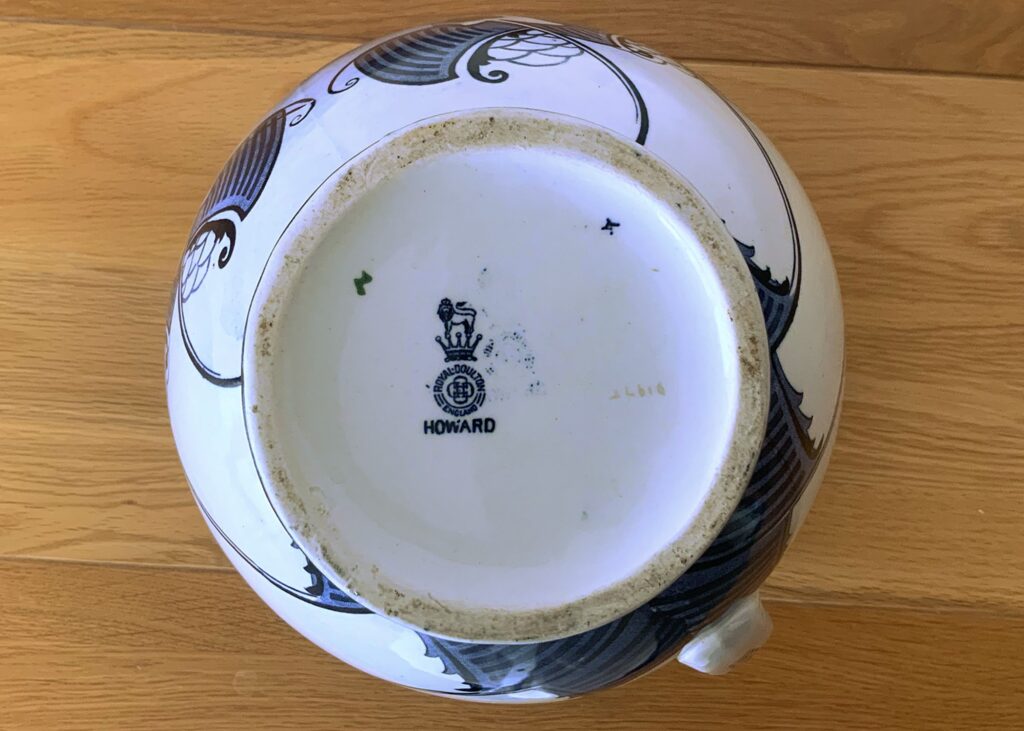
A Collector’s Guide to Royal Doulton Backstamps and Factory Marks
For collectors of fine English ceramics, few names command the respect and admiration of Royal Doulton. From the humble stoneware of early Lambeth to the intricate porcelain figurines of Burslem, Royal Doulton pieces tell a story of innovation, artistry, and industrial might spanning over two centuries.
But how do you truly authenticate, date, and assess the quality of these treasures? The secret lies not just in the glaze or the painting, but in the small, often overlooked inscription on the base: the backstamp.
Becoming a “Backstamp Detective” is the essential skill that separates the casual admirer from the serious collector. This comprehensive guide will arm you with the knowledge to decode the cryptic symbols, identify crucial factory marks, and spot the tell-tale signs of manufacturing defects that impact value.
1. The Anatomy of a Royal Doulton Backstamp
A Royal Doulton backstamp is rarely just one single mark. It is often a complex assemblage of data points, each providing a clue about the item’s origin, date, and the artisan who created it.
Before diving into specific eras, understand the common elements you might encounter:
A. The Primary Factory Mark (The Logo)
This is the most recognizable element—the shield, the name, or the famous Lion and Crown motif. This mark is the easiest way to place the piece within a broad historical period.
B. The Impressed Mark (The Hidden Date)
Often overlooked, these are numbers or letters pressed into the clay before firing. They are critical for dating stoneware and earlier pieces but can be faint and difficult to read, especially under heavy glaze.
C. The Registration Number (The Legal Clue)
Pre-1950, British manufacturers registered their designs with the Patent Office. This number, often preceded by “Rd. No.” or just “Rd.,” confirms the date the design (not necessarily the specific piece) was introduced.
D. The Artist or Painter Mark
Small initials, signatures, or sometimes a tiny symbol (like a cross or a star) designated the individual who painted or finished the piece. These are extremely valuable, as pieces by famous Doulton artists (like Hannah Barlow or Charles Noke) command a premium.
E. The Pattern or Series Number
Usually prefixed with a capital letter (e.g., D-series patterns), these four-digit numbers identify the specific decorative pattern (e.g., the Willow pattern or Blue Children series).
2. Decoding the Early Years: From Lambeth to Royal (1815–1902)
The history of Royal Doulton is a story of mergers, factory expansions, and evolving materials. The backstamps of this period reflect this chaotic but creative growth.
The Lambeth Era (Stoneware and Salt Glaze)
The earliest marks belong to the London factory established by John Doulton in 1815, known primarily for functional stoneware, pipes, and utilitarian objects.
Period | Manufacturer Mark | Key Characteristics |
1815–1854 | Doulton & Watts | Very simple marks, often stamped or impressed, focusing only on the company name and location (Lambeth). |
1854–1873 | Doulton & Co. | Marks become slightly more stylized. Many pieces remain unmarked or bear simple impressed numerals. |
1873–1891 | Doulton Lambeth | Marks are typically circular or oval. The term “Lambeth” is clearly included, differentiating it from the Burslem porcelain venture. |
1891–1914 | Doulton Lambeth (Mark with Crown) | Following Queen Victoria awarding a warrant, some marks include a small crown above the Doulton name, though the full ‘Royal’ title was yet to be granted company-wide. |
The Burslem Connection (Porcelain and China)
The crucial shift for collectors happens when Doulton partnered with Pinder, Bourne & Co. in Burslem, Stoke-on-Trent, in 1878. This factory specialized in fine china and porcelain, moving away from the heavy Lambeth stoneware.
Marks from the Burslem factory often feature a circular band with “DOULTON BURSLEM ENGLAND” surrounding a central element like a crown or coat of arms.
Crucial Identifier (1882–1902): Look for the word ENGLAND included in the mark. Its appearance signifies that the piece was manufactured after the 1883 Merchandise Marks Act, which required goods to be marked with their country of origin.
3. The Royal Era: The Lion and Crown Mark (Post-1902)
The most recognizable and ubiquitous mark in Doulton history began in 1901 when King Edward VII granted the company the Royal Warrant, allowing them to use the prefix “Royal.” The new iconic mark was unveiled in 1902.
A. The Primary Mark: The Lion and Crown
The standard mark, used widely after 1902, is an interlocking design featuring a crowned lion standing atop a circular band containing the name ROYAL DOULTON and often the location ENGLAND.
Pro Tip: If a piece uses the Lion and Crown mark but does not include the word “ENGLAND,” it may have been produced for export to the US market during periods when specific US trade laws discouraged the use of the country of origin. (This is rare but possible).
B. The Date Indication System: The Numbering Riddle (Post-1927)
While the Lion and Crown mark dates the piece to post-1902, precision dating requires understanding the numerical system Doulton employed, particularly between 1928 and the 1970s.
In 1928, Doulton standardized a system to mark the year of manufacture relative to the year 1927.
Mark Component | Meaning | Date Range |
A number directly adjacent or under the backstamp. | The number indicates how many years after 1927 the piece was made. | Example: A mark with a tiny ‘6’indicates manufacture in 1933 (1927 + 6 years). |
A small dot or slash. | Early iterations of the date code sometimes used small dots around the trademark instead of numerals. | The position and number of the dots related to the year, though this was less consistent than the numeral system. |
This impressed or printed number is the single most important tool for dating standard china and porcelain pieces from the mid-20th century.
C. The Post-1973 Mark Shift
Around 1973, Royal Doulton began simplifying its backstamps, often removing the highly complex date codes and moving towards more centralized, text-based marks that simply read “Royal Doulton England” or “Royal Doulton Bone China.”
For modern pieces (post-1970s), dating is often confirmed via the specific pattern number or by consulting company records, as the detailed numerical date codes were phased out.
4. The Detective’s Toolkit: Impressed Marks and Puce Markings
The backstamp is the headline, but the impressed and hand-painted marks are the fine print.
Impressed Year Numerals (The Earliest Clue)
Before 1928, Doulton sometimes used a simpler impressed year number (e.g., ‘05’ for 1905). This number is stamped into the clay and is usually separate from the printed backstamp. Be highly wary of reading isolated, impressed numbers, however; they can also refer to mold numbers or size codes.
Puce Marks and Colour Codes
Doulton used small, handwritten marks, often in a red-brown color (puce), applied by the painter or finisher.
- Artist Initials: Critical for high-value decorative wares. Initials like “FN” (Frank Noke) or “LB” (Leslie Booden) significantly increase value.
- Size Marks: A small letter (A, B, C, etc.) often indicates the size category of the article, usually found on jugs or vases.
- Pattern Codes (The D-Number): The pattern’s specific sequence number is almost always handwritten or stenciled in puce or black.
HN Numbers: Dating Figurines and Characters
For collectors of Doulton’s famous figurines (Character Figures and Ladies), the HN numberis paramount. Named after Harry Nixon, who managed the Doulton painting department, the HN number is assigned sequentially upon the figure’s introduction.
- HN 1 to HN 500: Extremely rare and valuable early pieces (1913–1920s).
- HN 500 to HN 1000: Pieces from the 1920s and 1930s.
- HN 2000 onwards: Mid-century and later.
While the HN number doesn’t reveal the specific month of manufacture, it instantly tells you the earliest possible date the figure could have been produced.
5. The Dark Side: Identifying Defects and Factory Seconds
A crucial part of being a backstamp detective involves assessing condition. While Doulton is known for quality, imperfections happen. A defect can drastically reduce value, and the factory often marked flawed pieces subtly.
Common Manufacturing Flaws
- Crazing: A network of fine, hairline cracks in the glaze (not the ceramic body). This occurs when the glaze and the body contract or expand at different rates over time, often due to age or improper handling. While sometimes inevitable, extensive crazing reduces value.
- Stilt/Spur Marks: Small, rough dots or triangular marks where the piece rested on stiltsduring the glaze firing process. These were chipped off post-firing. They are acceptable, but large, rough marks are considered a flaw.
- Black Specks (Pinpoints): Tiny black impurities trapped in the glaze. These are normal for pre-WWII pieces but should be minimal.
- Glaze Pooling: An uneven accumulation of glaze, often visible as a thick, slightly greenish or bluish area, typically near the footrim or handle joint.
Identifying Factory Seconds
If a piece had a significant flaw that did not compromise its integrity, Doulton sometimes sold it as a “second” at a discount. These pieces were almost always marked to prevent them from being sold as first quality.
The most common indicators applied by Royal Doulton include:
- The Grind Mark: A small, deliberate, usually faint abrasive mark (or grind) applied directly through the printed backstamp. This is the most common indication of a second from the mid-20th century onwards.
- A Single Score or Line: A small, handwritten line or score mark applied across the backstamp, often in the same puce color used for pattern numbers.
- The “S” Mark: Less frequently, an ‘S’ was handwritten near the backstamp, explicitly denoting a “Second.”
Warning for Collectors: If you find a valuable antique piece where the backstamp has been deliberately scrubbed or ground off entirely, it is a strong indication that it was a factory second whose mark was removed to deceive buyers.
6. The Rare and Exceptional Marks
Some specific Doulton markings signal scarcity or specialized production.
A. The “Trial Piece” Mark
Extremely rare, these pieces were prototypes or experimental wares. They may be marked with an impressed ‘T’ or the hand-painted words ‘Trial Piece’ or ‘Experimental.’ These are highly sought after by institutional collectors and museums.
B. Retailer Marks
Prior to WWI, Doulton often produced pieces exclusively for major retailers like Tiffany & Co. (New York) or Harrod’s (London). These pieces will include both the standard Doulton mark and the retailer’s name, sometimes superseding the Doulton mark entirely. Authentication must confirm that the style and body match the contemporary Doulton production.
C. The Post-Merger Marks (Royal Doulton Group)
In the latter half of the 20th century, as Doulton acquired other major British ceramic houses (e.g., Minton, Beswick), their backstamps often included wording like “A Member of the Royal Doulton Group.” While still Doulton products, these marks signify the evolving corporate structure.
Conclusion: The Value of the Stamp
The backstamp on a piece of Royal Doulton is more than just a manufacturer’s logo—it is a chronological footprint, a legal document, and often, an artist’s signature.
Mastering the dating systems, understanding the evolution from Lambeth stoneware to Royal Burslem bone china, and knowing how to spot a factory second are invaluable skills. For the Royal Doulton collector, the backstamp is the first, last, and most conclusive piece of evidence required to confirm authenticity and determine true market value.
Happy hunting, detective! May your magnifying glass always reveal the correct impressed number.